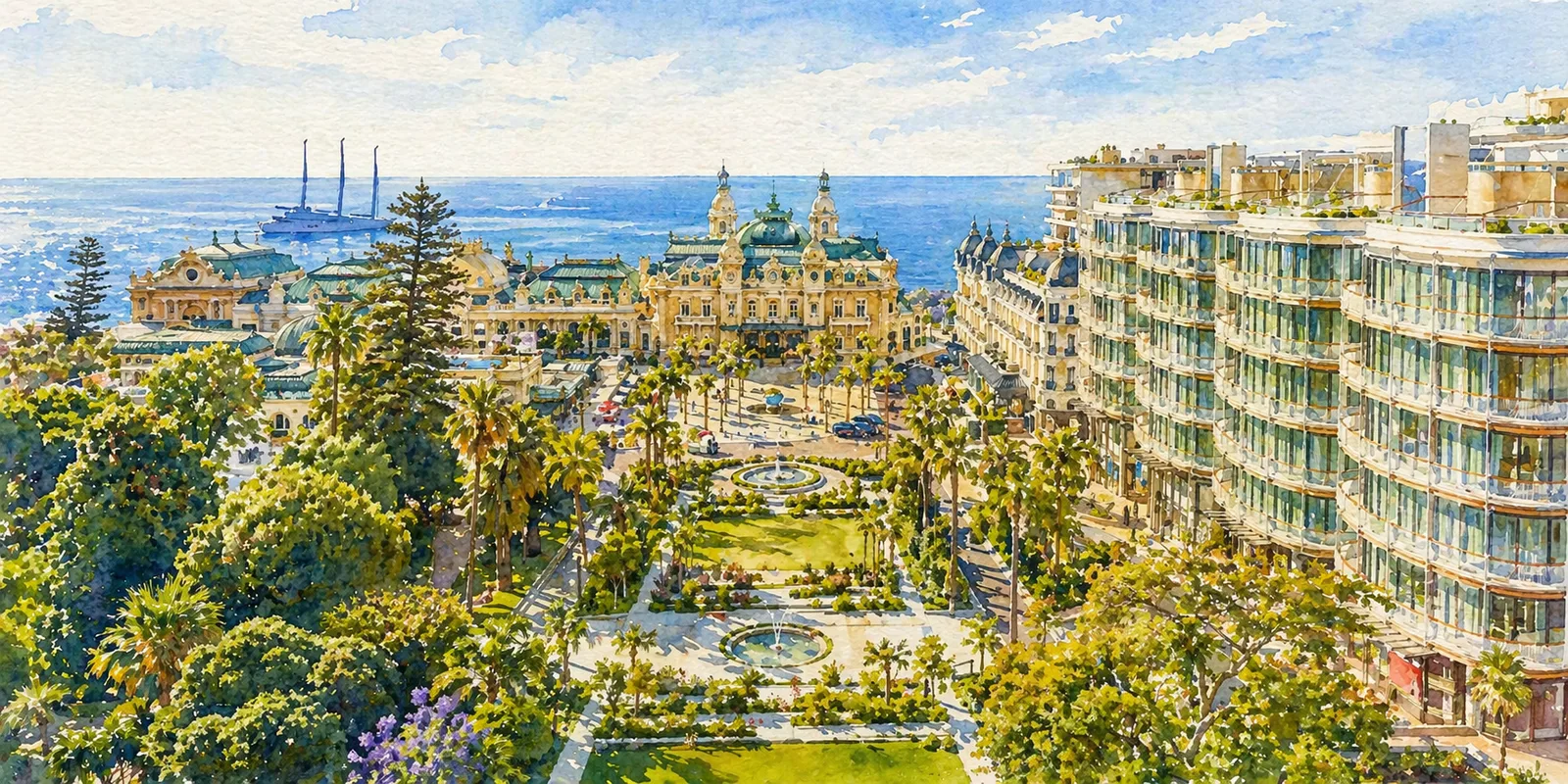
MonacoViews
Views of Monaco

Views of Monaco

Panoramic photography from the principality's finest vantage points, from harbour-level to the heights above Monte-Carlo

About Monaco's Panoramic Views

Monaco occupies less than two square kilometres, yet its vertical geography, from the seafront boulevards to the hillside roads high above, creates some of the most extraordinary panoramic views anywhere on the French Riviera. Views here are not simply an aesthetic feature; they are a defining characteristic of the principality itself.

The panoramas range from intimate harbour scenes to sweeping vistas that take in the full arc of the coastline, from Fontvieille in the west to Cap d'Ail in the east. Stand at Avenue de Varavilla at dusk and the entire principality unfolds below: the illuminated towers of Monte-Carlo, the Rock bathed in amber light, the marina shimmering with reflections, and beyond it all, the open Mediterranean. These are the views that define Monaco as a place to live.

All photographs on this page are original images taken on location in Monaco by the MonacoViews team: daytime panoramas, golden-hour and after-dark perspectives.

Gallery

21 original photographs — click any image to view full size

The Best Viewpoints in Monaco

Each of Monaco's vantage points offers a distinct perspective on the principality. Below, our team's original photography is paired with detailed notes on each location.

Avenue de Varavilla

Of all Monaco's panoramic vantage points, Avenue de Varavilla stands apart. High above Monaco-Ville, this quiet residential road offers one of the widest, most complete views in the principality: a sweeping arc that encompasses the Rock, the harbour, Fontvieille port, Monte-Carlo and, on clear days, the coastline reaching toward Cap d'Ail and beyond. Residents here rarely mention their address without mentioning the view. The perspective is compelling at any hour: bright and crystalline in the morning, warm and golden at dusk, and brilliantly illuminated after dark when the towers and marina lights create a spectacle that ranks among the finest night scenes on the French Riviera. Avenue de Varavilla is also the ideal vantage point from which to watch Monaco's celebrated firework displays, with the principality's skyline as a theatre backdrop.

Fontvieille Port

Fontvieille district

The western port of Monaco offers two distinct and complementary perspectives. From harbour level, looking east, the Rock of Monaco flanks to the right as the eye travels across La Condamine toward the Casino district, a classic composition that rewards photographers at every light. From the upper floors of Le Giorgione above the port, the angle reverses entirely: looking south-west, the Rock rises to the left and the open Mediterranean fills the frame, creating one of the most coveted private sea views in the principality. Fontvieille remains Monaco's most private and residential quarter; its streets see relatively few tourists, and its residents value precisely this discretion.

Mareterra and Larvotto Waterfront

Larvotto district

From Monaco's newest district, Mareterra, the camera looks north-west across the sandy arc of Larvotto beach and the principality's eastern coastline. The Mediterranean occupies the foreground while the towers of Monte-Carlo Bay Hotel and the Sporting district define the skyline above. Mareterra, an extension into the sea completed in 2025, adds a new perspective to Monaco's roster of viewpoints: one that looks back at the principality from the water's edge, rather than down upon it from the heights.

Grand Prix Circuit, near Tip Top

Monte-Carlo district

The most celebrated street circuit in motorsport winds through Monaco's city streets below. From the heights near the Tip Top bar, a local institution perched above the Mirabeau hairpin, the full scale of the track's extraordinary urban setting becomes clear. Hairpins, armco barriers and temporary grandstands occupy every available metre of the principality's narrow roads. Outside race week, the same streets carry ordinary traffic. Few urban views in the world carry such a weight of history.

The Eastern Border, La Rousse

La Rousse district

The La Rousse border marks Monaco's eastern boundary with France. The road leading to the border point is lined with palm trees and tropical gardens, a distinctly Monegasque streetscape giving way to the French side. Police maintain a presence at the border in both directions, and the road itself captures the contrast between the principality's immaculate upkeep and the wider Riviera beyond. Whether arriving or departing, this is one of the most recognisable transition points on the French Riviera.

The Principality's Threshold, Roquebrune Border

The iconic roundabout that marks the border between Roquebrune-Cap-Martin and Monaco, emblazoned with the principality's crest, functions as both a formal threshold and a statement of identity. Police maintain a constant, reassuring presence. Monaco's celebrated security begins at this very spot, with regular document and vehicle checks that contribute to the principality's reputation as one of the world's safest and most secure places to live. Looking east from the same point, the Maybourne Riviera Hotel crowns the cliffs above Roquebrune-Cap-Martin, a reminder that the luxury of the Riviera extends in both directions from this boundary.

The Japanese Garden and Jardin d'Eau

Larvotto district

The Japanese Garden of Monaco (Jardin Japonais) and the adjacent Jardin d'Eau occupy the boundary between Larvotto and Mareterra, offering a rare moment of contemplative stillness within one of the world's most densely built principalities. Designed by landscape architect Yasuo Beppu and opened in 1994, the garden follows traditional Japanese design principles: sculpted rock formations, still water features, timber bridges, a tea house and manicured pines that create a self-contained world separate from the surrounding city. The adjacent Vallee de la Pinede walkway links the garden directly to the Larvotto promenade and the new Mareterra district, making the garden the green anchor of Monaco's eastern end. For residents of Jardin d'Eau, Le Renzo and the Le Portier buildings, it is on the doorstep.

Why Views Define Value in Monaco Real Estate

In Monaco's property market, a view is not simply an aesthetic bonus; it is a primary determinant of value. Properties at altitude, facing south across the Mediterranean, command a substantial premium over those in the lower streets, even when separated by only a few hundred metres of vertical difference. This is partly practical: natural light, ventilation, and the psychological reward of an open horizon are measurably higher at elevation. But it goes beyond the functional.

To own a property with a genuine panoramic view of Monaco is to hold something that cannot be created or replicated. The principality has no undeveloped hilltops remaining. Every angle with an unobstructed sightline is already occupied: by a residence, a road, or a public garden. The photographs on this page represent the views that exist, as they exist today: the complete picture of the principality from its finest vantage points.

Buyers who have visited Monaco at night from Avenue de Varavilla, or looked out across the Mediterranean from the upper floors above Fontvieille port, rarely need further convincing. The view closes the sale.

The Best Times to Experience Monaco's Panoramas

Early morning, 7 to 9am

The sharpest clarity of the day, with overnight sea breezes washing the air clean and the light at its most directional. The Rock and the harbour are typically free of haze, and on clear mornings the mountains above Nice and Menton are visible on the horizon. For photography, this is the hour of crisp shadows and saturated colour.

Late afternoon and golden hour, 5 to 7pm (summer)

The hour that defines the Avenue de Varavilla photographs in this gallery. Warm light catches the towers of Monte-Carlo and the Rock simultaneously, and the harbour takes on a brilliance that is impossible to reproduce artificially. The colours shift through amber and rose as the sun descends behind the hills of Cap d'Ail, and the principality briefly glows.

After dark

Monaco becomes an entirely different proposition after nightfall. Monaco's strict planning codes require that buildings maintain illuminated facades facing the sea, creating the characteristic wall of light visible from cruise ships far out in the Mediterranean. The night views from above, the harbour shimmering with reflections and the towers burning with light, are among the most remarkable in Europe.

Firework nights

Monaco hosts some of the world's most celebrated firework displays, including the international competition held over Port Hercules each summer. The best viewing positions are elevated: Avenue de Varavilla and the heights above Fontvieille offer a clear sightline over the harbour with the city as backdrop. Residents in these locations rarely draw their curtains on these evenings.

Own a Home with These Views

Few decisions in property ownership are as lasting as the view from the window. In Monaco, where the highest-altitude addresses look south over the Mediterranean, east across the principality, or west to the hills of Cap d'Ail, the right view is a daily companion, one that changes with the season, the hour and the weather, and never diminishes.

If you are considering a property purchase in Monaco and want to understand what each district and altitude offers by way of view, the MonacoViews team can arrange private viewings designed around the outlook. We photograph every property we represent, and we are as attentive to the view as we are to the specification.

Frequently asked about Monaco views and photography

How were these Monaco panoramas photographed?â–¾
Every image is an original photograph taken in Monaco by the MonacoViews team, with the GPS coordinates of the vantage point recorded alongside. Nothing is sourced from stock libraries and nothing is AI-generated. Images are captured on location across different times of day to convey how each viewpoint actually reads: morning light, golden hour, and after dark.
Which Monaco viewpoint is best for panoramic photography?â–¾
Avenue de Varavilla offers the widest panoramic sweep of the entire principality, from Fontvieille port through Monte-Carlo to the Rock of Monaco. Fontvieille port itself frames the harbour and La Condamine looking east. Mareterra and the Japanese Garden give lower-level seafront perspectives towards Larvotto. The border roundabout at Roquebrune-Cap-Martin shows Monaco's eastern gateway with the Maybourne Riviera above.
Can I license or purchase these MonacoViews photographs?â–¾
Editorial and commercial licensing is available on request for real estate, publishing, and related uses. Contact the MonacoViews team via the Contact page with the intended use case, and we will reply with rates and usage terms. All images remain copyright MonacoViews unless explicitly licensed.
Are the coordinates and locations verified?â–¾
Yes. Coordinates are GPS-recorded on location and cross-checked against Monaco's verified MonacoViews reference set. This distinguishes MonacoViews panoramas from generic stock or street-view imagery: every vantage point on this page is locatable on the map to within metres.
Why do views matter so much for Monaco property?â–¾
Monaco is a small principality built into a steep amphitheatre overlooking the Mediterranean. The orientation, height, and exposure of an apartment can change its value by orders of magnitude. Sea view, harbour view, Casino view, garden view, and Grand Prix view are distinct and priced differently on the Monaco market. MonacoViews photographs the actual vantage points so buyers understand what they are buying, not just what an agency brochure claims.