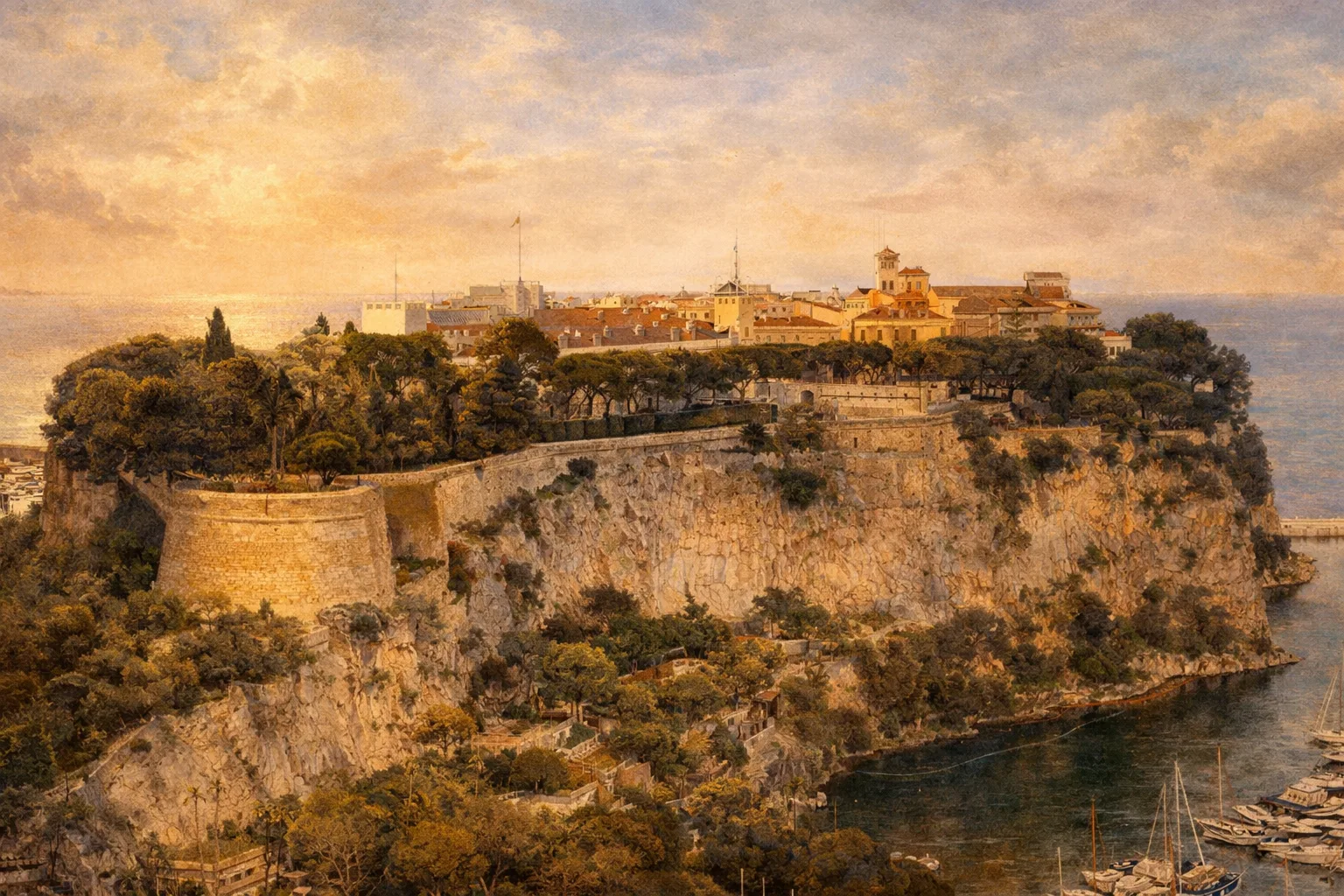
Buy Property in Monaco-Ville
Perched atop the ancient promontory known as Le Rocher, Monaco-Ville is the Principality's historic heart and seat of sovereign power. Narrow limestone streets open onto panoramic Mediterranean views, while the Prince's Palace and the Cathédrale de Monaco anchor a quarter that feels quietly apart from the bustle below. Residences here are rare, tightly held, and carry a gravitas that no modern tower can replicate.
About Monaco-Ville
Monaco-Ville occupies the dramatic rocky headland that juts into the sea between Port Hercule to the east and Fontvieille to the west. This is the oldest settled part of the Principality, and it wears its eight centuries of Grimaldi history with understated confidence. The streets are largely pedestrianised, shaded by mature trees, and lined with pastel-painted façades that house a handful of restaurants, artisan shops, and cultural institutions. It is, by some distance, the quietest quarter of Monaco.
The residential stock is extremely limited. Most properties are heritage apartments within converted townhouses, typically offering thick stone walls, period detailing, and commanding views over the harbour or the coastline towards Cap-d'Ail. New-build development is virtually non-existent here; planning constraints protect the quarter's architectural integrity. Owners tend to hold for decades, and turnover is among the lowest in the Principality.
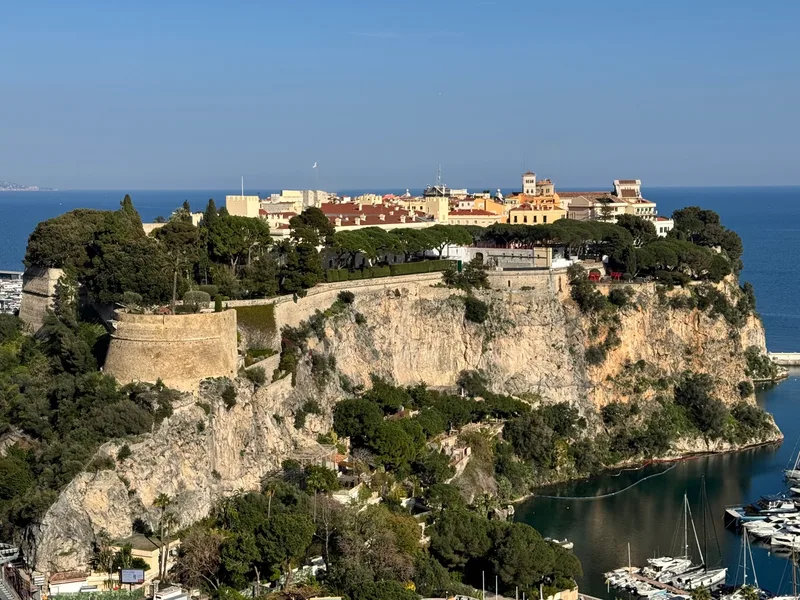
For the right buyer, Monaco-Ville offers something genuinely scarce: a sense of permanence and privacy within an otherwise fast-moving city-state. The pace is unhurried, the neighbours are discreet, and the daily reality is closer to a Provençal village than a global financial hub. It suits those who value heritage, tranquillity, and the quiet prestige of living on the Rock itself.
Investment and Market Context
Monaco-Ville is not a conventional investment district. Stock is exceptionally scarce, almost never marketed publicly, and acquired primarily through off-market introductions. For buyers without established agency relationships in the district, entry is structurally restricted.
The premium here is for heritage and rarity rather than contemporary specification. The absence of a concierge, gym, or pool is the norm rather than the exception.
For the right buyer, typically one seeking a long-term hold, a connection to Monegasque history, or simply a form of residential ownership that money alone cannot easily replicate, Monaco-Ville offers a unique proposition. Values here hold exceptionally well through market cycles precisely because supply cannot increase. The planning framework that prevents new development is, from an investor's perspective, a permanent structural guarantee of scarcity.
Living Experience
The Saint-Martin Gardens, established in 1816 and Monaco's oldest public gardens, run along the eastern edge of the Rock with views over the sea toward Cap-d'Ail and beyond. They provide Monaco-Ville's primary green space: mature trees, flowering borders, and a terrace walk that is among the most quietly beautiful public spaces in the city-state. The Musée Océanographique occupies an extraordinary position at the Rock's edge and operates both as a world-class research institution and as a public museum, one of the most visited sites in Monaco and a scientific institution of genuine international standing.
The Prince's Palace is open to public visits during the summer months, offering access to the State Apartments and a perspective on Monegasque sovereign history that has no equivalent elsewhere in the Principality. The Palais de Justice, Monaco's courts, and the principal governmental buildings of the Principality cluster around the central square. Fort Antoine, a converted eighteenth-century fortification, operates as an open-air theatre during the summer season, staging performances against an extraordinary backdrop of sea and sky.
Day-to-day retail in Monaco-Ville is limited and deliberately so, tourist-oriented shops along Rue Basse and a handful of restaurants and cafes serving the local and visitor population. There is no supermarket, no pharmacy of note, and no everyday commercial infrastructure. Residents descend to La Condamine for all practical daily shopping, which is a five-minute journey by the network of public lifts and a short walk across the port. The limitation is real but accepted as the price of an address that offers everything else in extraordinary measure.
Getting Around
Monaco-Ville is connected to the lower town primarily by a network of public lifts and escalators descending to La Condamine on the eastern side and to Fontvieille on the western. These links are efficient and free, running from early morning until late evening. Bus lines 1 and 2 serve the Rock, and the express service X1 provides direct connections to the upper districts. All routes descend quickly to Monaco-Monte Carlo train station, from which rail connections to Nice and the broader French network depart regularly.
The pedestrianised streets of Monaco-Ville itself make internal movement entirely on foot, the district is small enough that every address is within five minutes' walk of any other. There are no private car routes through the historic centre, and parking is handled at the base of the Rock. This absence of vehicles contributes substantially to the quarter's distinctive quiet and is, in the view of most residents, a feature rather than a limitation.
For travel beyond Monaco, the central road network is accessible within ten minutes via La Condamine, connecting to the A8 motorway and the Côte d'Azur road system. Nice Airport is approximately forty minutes by road or reachable via Monaco-Monte Carlo station and the regional train service. The Monaco Heliport in Fontvieille is a short lift descent away, providing the fastest connection to Nice Airport at approximately seven minutes by helicopter.
Living Experience
Living in Monaco-Ville is unlike living anywhere else in Monaco, and, in some respects, unlike living anywhere else at all. The streets are pedestrianised, the buildings are centuries old, and the pace of daily life is set by the tide of visitors during the day and by an almost complete stillness after they leave. By evening, the Rock is one of the quietest inhabited places on the Mediterranean coast: the cafes close, the last tour groups descend, and the handful of residents who call Le Rocher home have the promontory largely to themselves.
That privacy comes with genuine practical constraints. Daily shopping requires a descent to La Condamine, which is quick by lift but represents a deliberate journey rather than a door-step convenience. The absence of a supermarket, pharmacy, or everyday services on the Rock means that domestic logistics require more planning than in the lower districts. Residents universally describe this as the most significant practical adjustment of living in Monaco-Ville, not insurmountable, and eventually simply part of the rhythm of the place, but real.
What Monaco-Ville offers in return is something that the rest of Monaco, for all its resources, cannot manufacture: a genuine sense of historical continuity and physical separation from the commercial energy below. To wake in an apartment whose walls were built before the casino, before the Grand Prix, before the modern Principality, and to watch the harbour from a terrace that has overlooked it for generations, this is the Monaco-Ville proposition. It is niche, unhurried, and unlike anything the towers of La Rousse or the seafront of Larvotto can offer.
Frequently Asked Questions
How many properties are available in Monaco-Ville?
Stock almost never appears on the open market, and most transactions are completed off-market through established agency relationships. Buyers interested in the district should work with agents who have specific local expertise.
What type of properties exist in Monaco-Ville?
Almost all properties are heritage apartments within converted townhouses or small historic buildings. They typically feature stone walls, period detailing, and views over the harbour or sea. Modern amenity, concierge, gym, underground parking, is largely absent. The appeal is heritage, rarity, and outlook rather than contemporary specification.
Are property prices in Monaco-Ville the most expensive in the Principality?
No. This reflects the older stock, limited amenity, and practical constraints of the historic buildings. The premium here is for rarity and heritage rather than specification, and it operates differently from the luxury tower market.
What is it like to live in Monaco-Ville on a daily basis?
Very quiet and very private. The district is pedestrianised, and tourist traffic leaves by evening, when the Rock becomes genuinely still. Daily shopping requires a descent to La Condamine by public lift, quick but a deliberate journey. The pace of life is unhurried and the community very small. It suits buyers who prioritise discretion, heritage, and calm above all else.
Is the Musée Océanographique worth knowing about as a local?
The Oceanographic Museum is one of the world's leading marine research and exhibition institutions, founded in 1910. For residents of Monaco-Ville, it functions as a neighbourhood landmark and a world-class cultural resource in one. The cliff-face building itself, with its view over the southern sea, is one of the most architecturally remarkable structures in the Principality.
Living in Monaco-Ville
Character
The historic Rock of Monaco, home to the Prince's Palace, Cathedral, and Oceanographic Museum. Very limited residential availability.
Best For
- Heritage seekers
- History lovers
- Those seeking absolute tranquility
Transport
- CAM Lines 1, 2, 3, 4, 6 with 6 stops on Le Rocher and Place d'Armes
- Night buses N1 and N2 serve Monaco-Ville
- Express X1 links directly to Jardin Exotique on weekdays
- 10 MonaBike stations around the base of Le Rocher
- Public lifts from La Condamine and Port Hercule
Nearby Schools
- Lycee Albert Premier
- FANB
Shopping
- Tourist-oriented shops on Rue Basse
- Limited daily convenience
Dining
Traditional Monegasque restaurants and tourist cafes.
Green Spaces
- Saint-Martin Gardens (Monaco's first public gardens, since 1816)
Key Landmarks
Property Intelligence
We are aware of 20+ properties in Monaco-Ville on our database.
Register now and our team will deliver qualified, verified information directly to you.
Register now to receive more informationPlaces in Monaco-Ville
Hotels, restaurants and attractions in Monaco-Ville. Each listing includes directions, opening hours and bus routes.
Hotel
Restaurants
- Amici MieiVisit Monaco
- CastelrocVisit Monaco
- La MontgolfièreVisit Monaco
- La SalièreVisit Monaco
- La TavernettaVisit Monaco
- L'AuroreVisit Monaco
- Le Petit BarVisit Monaco
- Les Perles de Monte-CarloVisit Monaco
- Moshi MoshiVisit Monaco
- Pasta RocaVisit Monaco
- Pizzeria MonégasqueVisit Monaco
- P&PVisit Monaco
- Quai des ArtistesVisit Monaco
- TavoloVisit Monaco
- U’ CavagnetuVisit Monaco
- Amici Miei
Attraction
Monaco-Ville: Frequently Asked Questions
- What is the average property price in Monaco-Ville, Monaco?
- The average price in Monaco-Ville is approximately €40,000/sqm. Monaco-wide averages exceed €57,000/sqm, making it the most expensive residential property market in the world.
- Is Monaco-Ville a good area to buy property in Monaco?
- Monaco-Ville is one of Monaco's recognised residential districts with its own distinct character. All Monaco districts benefit from zero income tax, excellent security, and world-class infrastructure. The choice of district depends on lifestyle preferences — sea views, proximity to amenities, and building type all vary by location.
- Can foreigners buy property in Monaco-Ville?
- Yes. There are no restrictions on foreign nationals purchasing property in Monaco, including in Monaco-Ville. All transactions are handled by a notaire and take approximately 2 to 4 months to complete.
- How many residential buildings are in Monaco-Ville?
- MonacoViews documents a number of residential buildings in Monaco-Ville, each with first-party walkabout photography and verified location data. Register a buyer brief to be alerted when a property becomes available.